

No, the most expensive salt water pool test kit is not always the best choice. The right kit depends on your pool size, budget, and how often you test.
Strip kits, reagent comparators, and digital meters each have their own strengths. This guide looks at the best salt water pool test kits for 2026 so you can pick the one that fits your routine.
| Taylor K-1005 9-in-1 Pool Test Kit |  | Professional Grade | Test Type: 9-in-1 drop kit | Salt Testing: No | Chlorine Testing: Free/total chlorine | VIEW LATEST PRICE | Read Our Analysis |
| XtremepowerUS 5-Way Swimming Pool Test Kit |  | Best Budget | Test Type: 5-way drop kit | Salt Testing: No | Chlorine Testing: Chlorine/bromine | VIEW LATEST PRICE | Read Our Analysis |
| 8-in-1 Pool Test Strips for Salt Water Pools |  | Best Strip Kit | Test Type: 8-in-1 strips | Salt Testing: Yes | Chlorine Testing: Free/total chlorine | VIEW LATEST PRICE | Read Our Analysis |
| 2026 9-in-1 Pool Salt Test Strips (150 Counts) |  | Best for Salt Pools | Test Type: 9-in-1 strips | Salt Testing: Yes | Chlorine Testing: Free/total chlorine | VIEW LATEST PRICE | Read Our Analysis |
| Taylor K-2006-SALT 9-in-1 Pool & Spa Test Kit |  | Best Comprehensive Kit | Test Type: 9-in-1 drop kit | Salt Testing: Yes | Chlorine Testing: Free/combined chlorine | VIEW LATEST PRICE | Read Our Analysis |
| Pool Salt Test Strips 8-in-1 150 Count | Best for Routine Use | Test Type: 8-in-1 strips | Salt Testing: Yes | Chlorine Testing: Free/total chlorine | VIEW LATEST PRICE | Read Our Analysis | |
| Salt Water 8-in-1 Pool Test Strips Kit |  | Fastest Readings | Test Type: 8-in-1 strips | Salt Testing: Yes | Chlorine Testing: Free/total chlorine | VIEW LATEST PRICE | Read Our Analysis |
| 5-in-1 Digital Pool Salt Tester & pH Meter | 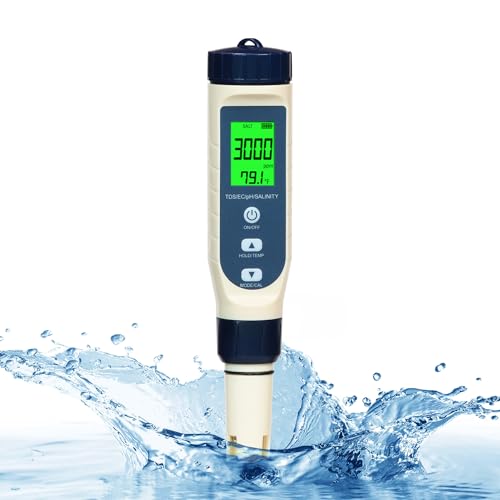 | Best Digital Tester | Test Type: 5-in-1 digital meter | Salt Testing: Yes | Chlorine Testing: No direct test | VIEW LATEST PRICE | Read Our Analysis |
More Details on Our Top Picks
Taylor K-1005 9-in-1 Pool Test Kit
The Taylor K-1005 brings professional-grade testing to your salt water pool routine. You can check free chlorine, total chlorine, bromine, pH, acid demand, base demand, total alkalinity, calcium hardness, and cyanuric acid with one kit. The comparator lets you collect and mix samples quickly, while the 13 DPD reagents deliver clear results. You’ll get simple instructions with pictograms, so testing feels straightforward. The durable case stores everything neatly. Made in the USA since 1930, Taylor backs you with trusted support and replacement reagents whenever needed for repeated seasonal use.
- Test Type:9-in-1 drop kit
- Salt Testing:No
- Chlorine Testing:Free/total chlorine
- pH Testing:Yes
- Alkalinity:Total alkalinity
- Cyanuric Acid:Yes
- Additional Feature:Comparator sample mixing
- Additional Feature:13 included reagents
- Additional Feature:Durable storage case
XtremepowerUS 5-Way Swimming Pool Test Kit
XtremepowerUS 5-Way Swimming Pool Test Kit gives you a budget-friendly way to check five water levels at home. You can test chlorine, bromine, pH, acid demand, and total alkalinity with its clear-view drop-testing block. The pH scale runs from 0 to 14, so you get broad coverage for pools, spas, and hot tubs. Its UV-protected color chips and accurate markings help you read results more easily. You also get a blue carrying case, plus instructions and a quick-reference guide. Store it cool and dry to keep it ready.
- Test Type:5-way drop kit
- Salt Testing:No
- Chlorine Testing:Chlorine/bromine
- pH Testing:Yes
- Alkalinity:Total alkalinity
- Cyanuric Acid:No
- Additional Feature:UV-protected color chips
- Additional Feature:Integrated color markings
- Additional Feature:Blue carrying case
8-in-1 Pool Test Strips for Salt Water Pools
Eight-in-1 strips give you a compact, all-in-one kit for saltwater pool care. You get 150 strips that test salt, pH, free chlorine, total chlorine, bromine, total alkalinity, hardness, and cyanuric acid in one quick dip. Just dip for 2 seconds, hold the strip level for 15 seconds, then match it to the color chart. The Nordic fiber paper helps prevent bleeding, so you see clearer results. With a 1,500–5,000 ppm salt range and beginner-friendly instructions, you can check your pool, spa, or hot tub fast and confidently.
- Test Type:8-in-1 strips
- Salt Testing:Yes
- Chlorine Testing:Free/total chlorine
- pH Testing:Yes
- Alkalinity:Total alkalinity
- Cyanuric Acid:Yes
- Additional Feature:150-count bottle
- Additional Feature:Nordic fiber paper
- Additional Feature:Easy 2-second dip
2026 9-in-1 Pool Salt Test Strips (150 Counts)
Need a reliable read on salt pools? The FUNSWTM 9-in-1 Pool Test Strips give you 150 total tests, including 140 multi-parameter strips and 10 copper-only strips. You can check salt from 0–6000 ppm, plus pH, total and free chlorine, bromine, alkalinity, hardness, cyanuric acid, and copper. Just dip, compare, and get quick color results on the included chart. They’re useful for saltwater pools, chlorine pools, spas, hot tubs, and year-round care. With a two-year shelf life, they’re a practical choice, though you’ll want to use them within 90 days after opening for best performance.
- Test Type:9-in-1 strips
- Salt Testing:Yes
- Chlorine Testing:Free/total chlorine
- pH Testing:Yes
- Alkalinity:Alkalinity
- Cyanuric Acid:Yes
- Additional Feature:Copper-only test strips
- Additional Feature:140 multi-parameter strips
- Additional Feature:Two-year shelf life
Taylor K-2006-SALT 9-in-1 Pool & Spa Test Kit
Taylor’s K-2006-SALT gives you a thorough 9-in-1 readout for saltwater pool care. You can test free and combined chlorine, pH, acid demand, base demand, total alkalinity, calcium hardness, cyanuric acid, and chloride in saltwater pools, spas, hot tubs, and both in-ground and above-ground setups. The comparator, 15 reagents, and pictogram instructions make testing straightforward. Because Taylor builds it in the USA to professional standards, you get reliable results and long service life. Should you test often, the K-2006C-SALT’s larger bottles give you more tests, and you can replace reagents individually.
- Test Type:9-in-1 drop kit
- Salt Testing:Yes
- Chlorine Testing:Free/combined chlorine
- pH Testing:Yes
- Alkalinity:Total alkalinity
- Cyanuric Acid:Yes
- Additional Feature:FAS-DPD high range
- Additional Feature:15 reagent bottles
- Additional Feature:Made in USA
Pool Salt Test Strips 8-in-1 150 Count
NewTest’s 8-in-1 strips make routine saltwater pool checks simple and reliable. You can test salt, pH, free chlorine or bromine, hardness, total chlorine, total alkalinity, and cyanuric acid in one quick dip. Just hold the strip in water for 2 seconds, lay it flat for 15 seconds, then match the colors on the bottle. The medical-industry-inspired pad design helps cut color bleed for clearer readings. With 150 strips, you’ve got about a year of twice-weekly monitoring for your pool, spa, or hot tub, and you’ll help keep water balanced and comfortable.
- Test Type:8-in-1 strips
- Salt Testing:Yes
- Chlorine Testing:Free/total chlorine
- pH Testing:Yes
- Alkalinity:Total alkalinity
- Cyanuric Acid:Yes
- Additional Feature:Medical-industry color formulation
- Additional Feature:Twice-weekly monitoring
- Additional Feature:One-year strip supply
Salt Water 8-in-1 Pool Test Strips Kit
AKSBTEC’s 2026 Salt Water 8-in-1 Pool Test Strips Kit gives you the fastest readings for saltwater pools. You get 150 PET strips and simple instructions in the PTS-8US-P model, so you can test salt, pH, free and total chlorine, bromine, cyanuric acid, total alkalinity, and total hardness. The salt range covers 1,500–5,000 ppm, with 2,700–3,400 ppm clearly marked. Just dip one second, wait 15 seconds, and compare the clean, bleed-free colors. It’s reliable for pools, spas, and hot tubs, and you don’t need any special tools.
- Test Type:8-in-1 strips
- Salt Testing:Yes
- Chlorine Testing:Free/total chlorine
- pH Testing:Yes
- Alkalinity:Total alkalinity
- Cyanuric Acid:Yes
- Additional Feature:1-second dip test
- Additional Feature:No color bleeding
- Additional Feature:40-gram lightweight kit
5-in-1 Digital Pool Salt Tester & pH Meter
This 5-in-1 digital tester suits pool owners who want quick, accurate salt and pH checks. You can also measure temperature, EC, and TDS with one handheld device, so you won’t juggle multiple tools. The titanium alloy probe helps you get fast, precise readings in pools, hot tubs, spas, aquariums, and hydroponic systems. It switches salinity units automatically between ppm, ppt, and %, and it covers broad ranges for seawater and food salt. Setup is simple: power on, press MODE, and test. Calibration stays easy, too.
- Test Type:5-in-1 digital meter
- Salt Testing:Yes
- Chlorine Testing:No direct test
- pH Testing:Yes
- Alkalinity:No direct test
- Cyanuric Acid:No direct test
- Additional Feature:Titanium alloy probe
- Additional Feature:Automatic salinity switching
- Additional Feature:Handheld digital design
Factors to Consider When Choosing a Salt Water Pool Test Kit
Whenever you choose a salt water pool test kit, look for one that covers the key parameters you check most often, like salt, pH, and chlorine. You’ll also want accurate salt-range readings, a format that fits your routine, and easy-to-use results you can trust. In case the kit uses reagents or strips, make sure replacements are easy to find and affordable.
Test Parameter Coverage
A good salt water pool test kit should cover the core numbers that actually keep your pool balanced: salt, free chlorine, total chlorine, pH, and total alkalinity. You need salt testing in the range your system uses, with a clear ideal band for salt-chlorinator pools. Free chlorine shows how much sanitizer is working, while total chlorine helps you spot combined chloramines. pH and total alkalinity should come together, because alkalinity helps steady pH, and both affect comfort and sanitizer performance. Should you run a salt system with stabilizer, add cyanuric acid testing. For hard water, calcium hardness matters too. You might also want bromine, high-range chlorine, or copper/metal tests provided your pool setup requires them.
Salt Range Accuracy
To get useful salt readings, make sure the kit matches your pool’s real operating range—most salt systems run around 2,700–3,400 ppm, with roughly 2,500–3,500 ppm considered acceptable—so the scale should clearly cover that zone. You should also want at least 100 ppm resolution near that target, because 500–1,000 ppm jumps can hide changes that affect your chlorinator. Check the stated accuracy, too; a tolerance of ±100–200 ppm tells you how far the result could drift from the true setpoint. Clear color blocks or a digital display help reduce reading mistakes. Finally, confirm the kit’s minimum and maximum range can catch low salt that hurts chlorine output and high salt that can speed corrosion, ideally spanning about 1,500–6,000 ppm.
Digital Vs Strip
Choosing between a digital tester and strips comes down to how precise you need to be and how often you test. Should you want exact numbers, digital meters give you salinity, pH, TDS, EC, and temperature readings, often up to 9,999 ppm, so you can make tighter adjustments. They also show values in ppm, ppt, or percent, which helps you compare results fast. Strips cost less per test and give quick multi-parameter checks, but their color results can shift with lighting, timing, and pad contamination. Digital units cost more upfront and need calibration and probe care, yet they avoid guesswork and usually stay more consistent. When you test routinely and just need a broad snapshot, strips work well; should you fine-tune water chemistry, digital’s the better choice.
Ease Of Use
Beyond accuracy, the easiest salt water pool test kit is the one you’ll actually use on schedule. In the event you test often, pick a kit with a simple sampling method, like a comparator cup or single-dip strip, so each check takes just a few minutes. You’ll also want clear, high-contrast color charts or a digital readout, because they cut down on guesswork and reading mistakes. Look at the timing, too: in case a test needs a 15-second wait, make sure that fits your routine and setting. Consider how many parameters you need at once. A one-dip strip feels easier than a multi-reagent workflow, while a digital probe can suit you in the event you want less manual handling and a straightforward process.
Reagent Replacement
Whenever you’re comparing salt water pool test kits, look closely at reagent replacement so you know what you’ll actually need to restock later. Check which reagents the kit uses, such as DPD or FAS, and confirm which bottles are consumables so you can replace only what’s empty. Pay attention to bottle sizes, since many run just 0.75 to 2 ounces, and estimate how many tests you’ll get from each one based on how often you test. Before you buy, verify replacement packs are available from multiple suppliers and compare prices so you don’t get stuck waiting for a missing chemical. Also, follow storage and shelf-life guidance, and keep a simple log of lot numbers, open dates, and expiration dates to stay accurate.
Build Quality
At the point you compare salt water pool test kits, pay close attention to build quality because it affects accuracy and how long the kit lasts. You should choose models made from UV-resistant plastics or corrosion-resistant metals that can handle pool chemicals and sunlight without cracking or rusting. Check the color comparator or test block next; integrated color chips or engraved scales won’t fade as fast, so your readings stay reliable. Make sure reagent bottles and caps seal tightly and resist chemicals to limit evaporation and contamination. Precision-molded wells, droppers, and strip housings help prevent cross-contamination and keep sample volumes consistent. Should you desire better long-term value, look for kits with replaceable reagents and spare parts, since professional-grade designs usually last longer than disposable-only options.
Storage And Portability
After checking build quality, consider how you’ll store and carry the kit, because even a well-made tester can give unreliable results whether it’s exposed to heat, sunlight, or moisture. Store strips and reagents in a cool, dry place away from direct sunlight and humidity to keep chemicals stable. Keep reagent bottles tightly sealed, upright, and in their original labeled containers to reduce contamination and evaporation. Check the manufacturer’s shelf life, and discard opened strips or reagents once the recommended period ends, often 90 days for strips. For portable testing, pack everything in a rigid carrying case with compartments so vials, comparators, and strips don’t crush or shift. Should temperatures rise, use an insulated pouch, and keep materials away from heat sources and chemicals like bleach or pool shock.
Pool Type Compatibility
Whenever you choose a salt water pool test kit, make sure it matches your water type and measures salt or salinity in ppm, because many standard chlorine-only kits leave that out. You should confirm the kit’s salt range covers about 2,500 to 3,500 ppm, so your reading lands inside its measurable span. Also, check that it tests free chlorine, total chlorine, and cyanuric acid, since salt systems still need balanced sanitizer levels. Should you use bromine, verify that option too. For spas or hot tubs, pick a kit designed for smaller volumes and warmer water, because heat can change sanitizer performance. In case you manage a pool and spa together, make sure one kit supports every parameter and range you need.
Frequently Asked Questions
How Often Should I Test My Salt Pool Water?
You should test your salt pool water at least once a week, and more often after heavy use, rain, or chemical adjustments. You’ll keep levels stable, protect equipment, and enjoy clearer, safer water.
Can Salt Test Kits Measure Chlorine and pH Together?
Yes, you can, but only provided you choose a kit built for it—think Swiss Army knife, not single-blade. You’ll test chlorine separately from pH, and some kits also read salt, stabilizer, and alkalinity.
Do Pool Test Strips Expire After Opening?
Yes, you should expect them to expire after opening. You’ll get the best results provided you store strips tightly sealed, dry, and cool, and use them before the manufacturer’s date for accurate readings.
Are Digital Pool Testers More Accurate Than Strips?
Yes—digital testers usually give you more consistent readings than strips, but you still need to calibrate them. Consider strips as rough sketches and digital meters as sharper portraits; you’ll trust the latter more often.
How Do I Store Pool Test Kits Properly?
You should store your pool test kit in a cool, dry place, away from sunlight and chemicals. Keep caps tight, rinse tools after use, and don’t let reagents freeze or overheat.
