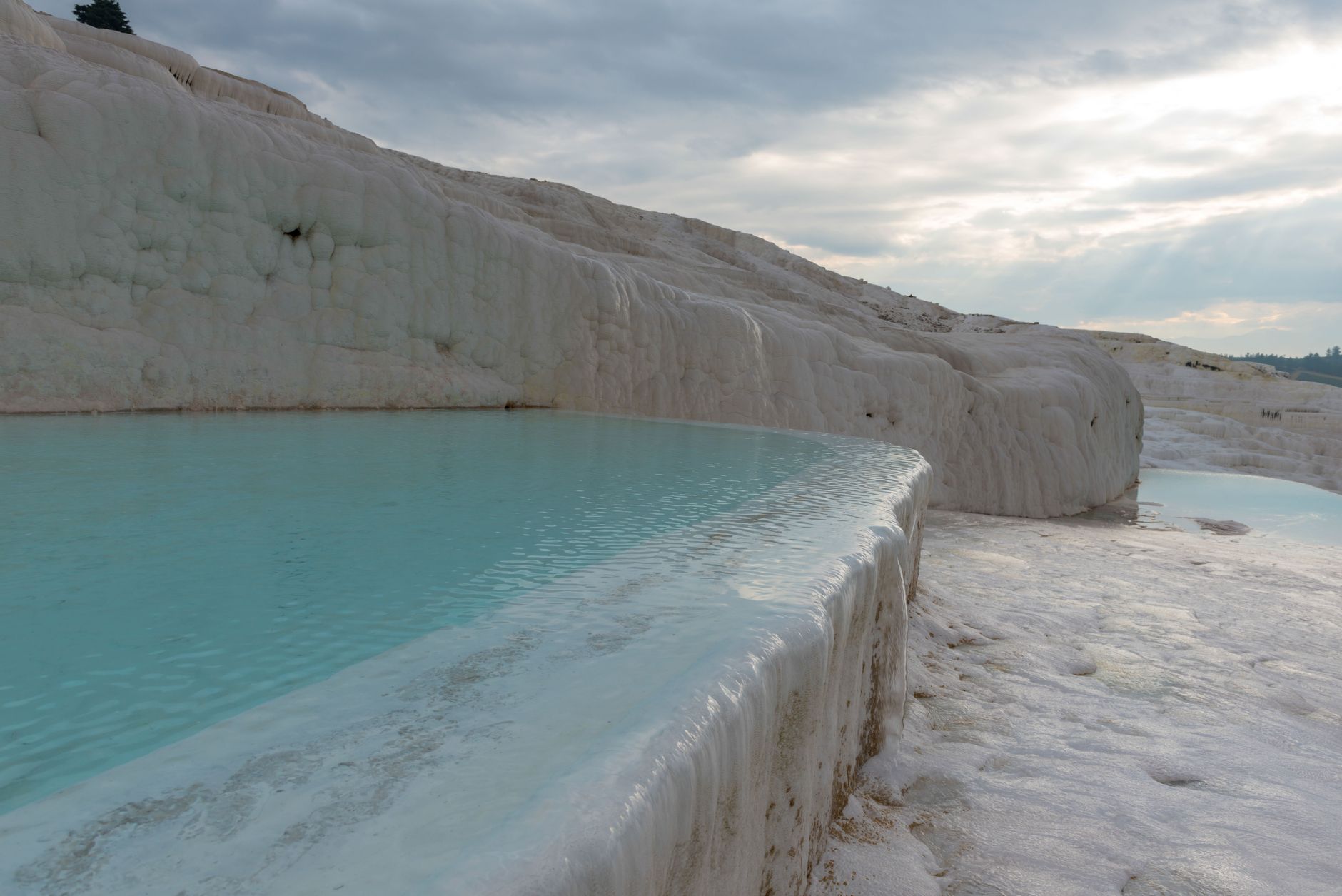

Pool calcium removal is the process of clearing calcium carbonate scale from tile, plaster, grout, metal parts, or equipment without pretending it will lower dissolved calcium in the water in one step. A chalky waterline, rough plaster, or crust on a heater cell usually points to calcium buildup, not algae or dirt.
If you are dealing with white buildup and trying to protect the finish, the right fix starts with identification and ends with water balance. The goal is to remove calcium scale from pool surfaces with the least aggressive method that still works.
Identifying Calcium Scale Before You Clean
A hard, gritty deposit is the usual clue. Calcium scale clings to the tile line, resists a normal pool brush, and feels rough under a gloved hand, while algae wipes slimy and dirt smears instead of crusting.
The fastest way to avoid damage is to test the texture first. A white film that behaves like a mineral shell often shows up where water chemistry changes fastest, especially along the waterline, on grout, or near warm equipment.
What calcium looks like on pool surfaces
On pool plaster, the deposit often appears as a chalky band that tracks the waterline. On tile, it can form a raised ridge that looks like dried plaster dust, while grout traps the mineral in narrow seams and makes it harder to remove calcium scale from pool surfaces.
Metal parts tell a different story. Ladders, handrails, and heater internals can collect a hard shell that starts thin and thickens near heat or turbulence, which is why calcium buildup often shows up there before it becomes obvious elsewhere.
Why the wrong diagnosis wastes effort
Brushing calcium buildup with chlorine does almost nothing, because chlorine handles sanitation, not mineral deposits. Metal stain removers can also make things worse if the mark is actually calcium carbonate, and that kind of mistake costs time plus finish life.
Take a minute to check the texture before you grab a cleaner. A hard white crust points you toward pool calcium deposit removal, not stain treatment.
Once you know what you are touching, the next step is figuring out why the water became scale-prone in the first place.
Because the deposit forms for a reason, the chemistry behind it determines whether cleaning will actually last.
Why Pool Water Turns Scale-Prone
That crust usually starts with water chemistry, not a surface defect. High pH, high calcium hardness, warm water, and rising alkalinity push dissolved minerals out of solution until calcium scale forms on the nearest surface.
Evaporation makes the problem worse because the water leaves and the minerals stay behind. Each top-off can raise calcium hardness a little more, which is why lower calcium scaling in a pool depends on both surface care and source water control.
Heat and evaporation do the damage fastest
Heaters and salt cells often scale first because both create local hot spots. Heat lowers calcium solubility, and a salt chlorine generator can create a high-pH zone at the plates, so a small patch of water turns into a mineral shelf.
That same pattern shows up in many service calls. The bulk water may test close to range while the heater core or cell still crusts over, which is why a good test kit matters more than a quick glance.
What pH changes can and cannot do
Lowering pH can soften the water’s urge to scale and may loosen some fresh deposits. It does not remove calcium hardness in pool water, so the dissolved mineral load stays in place until you dilute it or treat the water more aggressively.
That split between surface buildup and dissolved minerals shapes the cleaning choice. Surface work fixes the visible crust, while water work reduces the cause.
Visible crust is only part of the story; the underlying water balance decides how stubborn it becomes.
Matching the Removal Method To the Surface
Surface type decides how hard you can push. Tile and exposed grout tolerate more than vinyl, while pool plaster sits in the middle and metal parts need the most caution because harsh cleaners can etch, pit, or strip plating.
Use the least aggressive method that clears the deposit. A method that works on tile can scar plaster or wrinkle vinyl, and that tradeoff matters more than speed when the finish still has years left in it.
Choose the lightest effective method
| Surface | Safer starting point | Use extra care with |
|---|---|---|
| Tile | Brush, nylon pad, mild acid cleaner | Pumice stone on glossy glaze |
| Plaster | Brush, diluted acid cleaner, controlled spot work | Repeated acid washes |
| Grout | Small brush, low-pressure scrub, mild cleaner | Strong acid on soft joints |
| Metal | Manufacturer-safe cleaner, soft cloth | Acid on plated parts |
| Vinyl | Soft brush and water balance correction | Pumice and harsh acid |
| Pebble | Soft brush, spot cleaner, careful rinsing | Abrasive pads that open pores |
A pumice stone can remove white scale from pool tile, but it can scratch glazed surfaces and leave visible wear on softer finishes. Vinegar is mild enough for tiny spots, yet it struggles with hard mineral crust, while muriatic acid works faster but can etch plaster and attack metal quickly.
Always test a cleaner on a hidden patch instead of the center of the waterline. A minute of restraint can save a finish that took years to cure.
Heaters, salt cells, and fittings need special care
Heater tubes, salt chlorine generator plates, and light fixtures are the parts most likely to fail after repeated scaling. Acid in the wrong concentration can shorten their life, and metal fittings can discolor fast.
For light deposits, brushing after you correct water balance can loosen the crust. For thick buildup, hand tools stop helping and the problem moves into active descaling, which is where a pool professional often becomes the safer choice.
Once the finish choice is clear, the harder question is whether the crust still responds to brushing or has already hardened into a mineral shell.
When brushing no longer loosens the deposit, the problem has shifted from a surface film to a harder mineral layer.
When Scrubbing Stops Working
Fresh scale can loosen after a pH correction and steady brushing. Once the deposit hardens, the surface starts fighting back, and calcium buildup on plaster often needs more than plain brushing to budge it.
Heavy buildup is the dividing line. At that point, acid-based cleaning, bead blasting, or a professional descaling service becomes more realistic than another round with a pool brush.
Signs the deposit has crossed the line
- Brush marks vanish: The crust stays put after several passes with a pool brush.
- Rough edges spread: The deposit extends beyond the waterline into tile grout or plaster pores.
- Equipment flow drops: Heater output or circulation weakens from internal mineral buildup.
- White rings return fast: The same spot rebuilds within days after cleaning.
- Surface looks etched: The finish has lost its sheen and feels sandpapery.
Where acid washing fits, and where it does not
Acid washing can remove carbonate scale from pool plaster and some exposed aggregate by dissolving part of the deposit. That same action also removes a thin layer of the surface, so repeated washing shortens finish life.
On vinyl, fiberglass, and many metal parts, the risk outweighs the benefit. A common failure pattern is simple: the owner removes white scale from pool tile or a cell, but the water still runs scale-prone, so the buildup comes back fast.
That cycle keeps repeating until the water itself is treated, not just the white residue on the surface.
Reducing Calcium Hardness In The Water
Surface cleaning clears the crust you can see. Reducing calcium hardness in pool water tackles the source in the water itself and makes future pool calcium removal much easier to maintain.
There is no simple bottle that strips calcium from pool water on contact. The practical paths are dilution with lower-hardness water, reverse osmosis service, or partial drain and refill.
Partial drain and refill works in the right setting
Partial drain and refill makes sense when the fill water is softer than the pool water and the shell can safely handle a lower water level. That method lowers calcium hardness along with other dissolved solids, but it can be risky in high groundwater areas or where a plaster shell should not sit exposed for long.
A plaster pool at 700 ppm calcium hardness is a common example. Swap part of that water with lower-hardness fill water, and the scale pressure drops; do the same thing with equally hard fill water, and the result is barely noticeable.
Reverse osmosis suits very hard pools
Mobile reverse osmosis service removes dissolved minerals from the pool water and returns it with far lower hardness. It is useful in drought-restricted regions, desert climates, or anywhere draining the vessel would waste too much water.
It does not solve hard source water, though. Once top-off water starts climbing calcium again, the number drifts upward, so testing before and after the service matters.
| Method | Best use case | What it changes |
|---|---|---|
| Partial drain and refill | Moderately hard pool water with softer fill water | Calcium hardness, TDS, other dissolved minerals |
| Reverse osmosis | Very hard water or restricted drainage | Calcium hardness with less water loss |
| Surface cleaning alone | Visible crust with water already near target range | The deposit, not the water source |
The practical rule is simple. Softer fill water and a sound shell point you toward drain and refill. Extremely hard water, water-use limits, or a pool that cannot sit empty point you toward reverse osmosis.
Those limits make prevention the safer path, since stable chemistry is easier to maintain than repeated correction.
Keeping Scale From Coming Back
Scale returns when pH, alkalinity, calcium hardness, temperature, and evaporation push the water back into oversaturation. The Langelier Saturation Index helps you judge that balance, but the daily habit is simpler: test, adjust, and retest after any major water change.
Pool owners who top off often see hardness creep upward month by month. Waterline scale is tied to evaporation because the water leaves and the minerals stay, which is why sunny, hot backyards see repeat buildup so often.
Daily habits that slow recurrence
- Keep pH steady: Stay in the pool-care range, not the high end that favors calcium carbonate.
- Watch alkalinity: High total alkalinity can feed scale even when pH looks acceptable.
- Track hardness: Test calcium hardness after heavy top-off or a long dry spell.
- Manage heat: Run heaters only as long as needed, since warm water scales faster.
- Brush waterlines: Quick brushing stops fresh film from hardening into crust.
- Check the cell: Salt cells and heater parts need inspection before crust becomes a blockage.
After backwashing, heating, or a week of heavy evaporation, test again. Those are the moments when calcium balance shifts fast enough to surprise you.
Use saturation balance, not a single number
Calcium hardness alone does not tell the whole story. A pool with moderate hardness can still scale at high pH and high temperature, while a harder pool may stay stable with better balance.
The Langelier Saturation Index and calcium saturation calculations explain that difference better than one test strip ever will. Sequestrants can hold calcium and some metals in solution for a while, but they are not a cure and they fade over time.
That is why balanced water chemistry beats endless spot cleaning. It lowers calcium scaling in a pool by fixing the conditions that let the deposits form.
A steadier balance means fewer deposits, and that practical lesson brings the discussion to a close.
Wrap Up
White crust is a water-balance problem wearing a surface stain. Clear the deposit with the gentlest method that fits the finish, then reduce calcium hardness in pool water and correct the pH and alkalinity conditions that caused it.
That two-part approach protects pool plaster, tile line surfaces, and equipment far better than scrubbing alone. It also gives you a cleaner path for pool calcium deposit removal the next time the water starts to drift.
FAQ
What causes calcium buildup in a pool?
High pH, elevated alkalinity, warm water, evaporation, and rising calcium hardness push calcium carbonate out of solution and leave buildup behind. Heaters and salt cells often scale first because heat and local pH spikes speed up precipitation.
How do I tell if my pool has calcium scale or another type of stain?
Calcium scale feels hard, gritty, and crusty, while algae feels slimy, dirt smears, metal stains usually discolor the surface, and efflorescence often looks like a powdery salt film from masonry. A gloved hand test on the waterline, grout, or a heater fitting usually gives the clearest clue.
What is the safest way to remove calcium from pool tile, plaster, or equipment?
The safest path is to start with the least aggressive method that matches the surface, then step up only if needed. Tile may tolerate a nylon pad, plaster may need a diluted acid cleaner, and equipment usually needs manufacturer-safe products because muriatic acid, pumice stone, and bead blasting can cause damage.
Can I use vinegar, muriatic acid, or pumice stone on pool calcium deposits?
Vinegar can work on tiny spots, but it struggles with hard scale. Muriatic acid removes deposits faster, yet it can etch plaster and attack metal, while a pumice stone can scratch glossy tile and wear softer finishes.
Will draining the pool help remove calcium scale?
Draining can help only when the shell can safely handle it and the fill water is softer than the pool water. It lowers calcium hardness, but it can create structural risk in high groundwater areas and will not solve the problem if your source water is already hard.
How do I prevent calcium buildup from coming back?
Keep pH, total alkalinity, calcium hardness, and temperature in a stable range, and retest after topping off, backwashing, or long evaporation periods. Water balance is the real control point; surface cleaning only resets the visible sign.