
Through a nozzle, arc, or smooth sheet, this decorative water feature moves water to add sound, surface motion, and visual interest. It can help with aeration and mixing, but it does not replace the pool pump, filtration, or chemical balance.
If you are weighing a backyard upgrade, the real decision is how the feature will fit your pump, deck space, budget, and maintenance tolerance. The best choice depends on spray pattern, installation complexity, and how much water movement you actually want.
What A Pool Fountain Actually Does
Water leaves a nozzle, arcs or fans out, then falls back into the basin. That motion softens a still surface and adds a low rush near a patio or lounge area.
The hydraulic setup can tie into the main circulation loop or run on a dedicated pool fountain pump. A shared loop keeps the system simpler, while a separate pump gives you more control over flow, sound, and run time.
Performance is not just about horsepower. Nozzle size, pipe friction, and total dynamic head decide whether the spray looks crisp or sputtery, and the wrong match can leave weak arcs and extra noise.
A good fountain helps water move, but it does not replace filtration. The EPA and CDC both treat circulation and disinfection as core pool functions, so the decorative feature is a helper, not the main system.
Because circulation and disinfection come first, the real question is which design best supports both function and style.
The Types That Shape Performance And Look
That visual payoff changes fast once you compare stream shape, splash level, and sound. A deck jet, a floating unit, and a sheer descent each move water differently.
The right swimming pool fountain style depends on the mood you want and the amount of water you can spare for spray and evaporation. Some options stay quiet and low, while others create a louder, more noticeable water line.
Floating units and simple bubbler styles
Floating models sit in the water and are easy to add to some residential pools. Bubblers send a shorter, gentler plume that works well on tanning ledges, shallow shelves, and spaces where movement is wanted without much spray drift.
These styles suit homeowners who want a softer effect and less deck wetting. They also stay lower in the sight line, which helps in smaller yards where a tall arc would feel out of scale.
Deck jets and laminar arcs
Deck-mounted jets project water from the coping or deck edge. Laminar flow systems make a smooth, glass-like arc, while aerating jets break the stream into a livelier spray that catches sunlight and throws more sound.
Those two versions serve different goals. Laminar arcs fit calm, polished designs; aerating jets suit owners who want movement and a stronger audible cue near seating areas.
Sheer descent and sheet water features
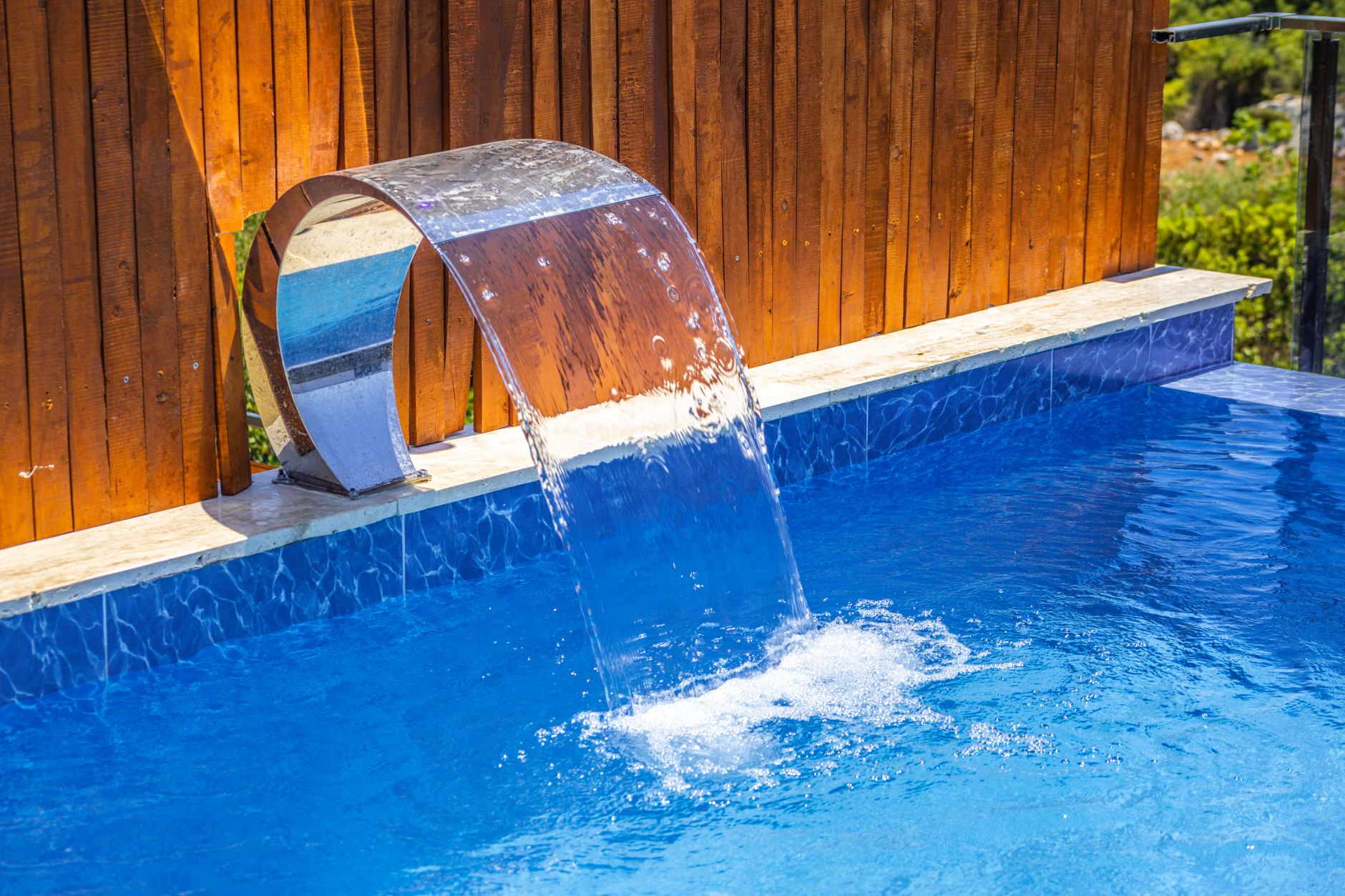
Mounted on a wall or raised edge, these units send water in a thin curtain that catches the light as it falls. The effect is quieter than a tall spray and works well where a clean line is wanted rather than a fountain-like burst.
Hotel pools and modern patio builds use this style because it reads as architecture as much as ornament. The water looks controlled, which is why it pairs well with minimal tile, stone, or concrete finishes.
| Style | Visual effect | Best fit |
|---|---|---|
| Floating unit | Soft plume, low splash | Small residential pools and shallow shelves |
| Deck jet | Arcing stream from the deck | Backyards that want movement without a large structure |
| Laminar arc | Smooth, clear water ribbon | Calm, clean designs and evening lighting accents |
| Sheer descent | Even sheet of water | Modern pools and wall-mounted features |
| Bubbler | Compact, foamy rise | Ledges and shallow lounge zones |
Orenda Technologies notes that water features change circulation demand, evaporation, and noise, so the look also changes operating behavior. That is why a dramatic spray can feel wrong in a windy yard even when it looks great in still weather.
The next question is less visual and more practical: what that movement does for the water itself.
That distinction matters most when the water’s motion starts affecting clarity, temperature, and overall balance.
Why Water Movement Matters More Than Appearance Alone
Surface agitation breaks up dead zones near the top of the water column. That can help mix warmer surface water with cooler lower layers, and it can help dissolved gases exchange more quickly with the air.
Cornell Cooperative Extension materials on water quality note that circulation and aeration can reduce stratification and support clearer conditions. In pool use, that means a decorative feature can help the water feel fresher, especially near corners and steps where water may sit still.
The benefit has limits. A weak pump, clogged filtration, or poor return layout can leave the main pool stagnant even while the fountain itself looks active, and splashy features can raise evaporation and pH drift through heavier aeration.
Mosquitoes also prefer standing water. The CDC and EPA both tie stagnant water to breeding and odor problems, so motion has a health angle as well as a cosmetic one. Still, chlorination and filtration carry the real load, which is why sanitizer levels and water testing stay central.
That balance matters when you compare real-world use, because a feature that improves mixing can still create extra evaporation and cleaning if the setup is mismatched.
Those tradeoffs become even more important once hidden safety concerns and code details enter the picture.
Watch the pattern, not just the height. A clean stream tells you the plumbing has enough pressure, while sputtering or drifting spray often points to head loss, nozzle wear, or wind exposure.
Safety, Codes, And The Parts People Miss
Pool safety codes do more than regulate drains. They also cover barriers, circulation, disinfection, and entrapment prevention around water features, because decorative motion can hide a hazard or distract a swimmer near the edge.
The U.S. Consumer Product Safety Commission stresses visibility, supervision, and safe placement of water features. The International Swimming Pool and Spa Code and local electrical rules shape bonding, GFCI protection, and shutoff access for any powered feature near a swimming pool.
Slip hazards show up fast around splash zones. A wet deck, smooth stone, and windblown mist can turn a patio into a slick surface, especially where a deck jet lands close to the walking path.
Safe mounting matters too. Wall brackets, return fittings, and nozzle assemblies need secure anchoring and enough clearance for maintenance, or vibration and backflow can turn a simple feature into a recurring repair.
Municipal pools and hotel pools face the tightest controls, and they also need regular inspection of return lines, strainers, and fittings. The bigger the feature, the more the code and the installer shape what is allowed.
That brings the focus to installation, where cost and reliability are set long before the first spray hits the surface.
From there, the details inside the pool room determine whether the feature stays dependable or turns costly.
Installation Choices That Affect Cost And Reliability
Pump curve, nozzle size, pipe friction, and total dynamic head decide how well the feature runs. A strong pump on a restrictive line still performs badly, because friction through elbows, valves, and long runs steals pressure before water reaches the nozzle.
Pool fountain installation choices also affect energy use. A well-matched system can run on a lower setting and still look clean, while a poor layout often pushes you toward a larger pump than the feature really needs.
Pump sizing and flow balance
A variable-speed pump gives you more control than a basic single-speed unit. The U.S. Department of Energy notes that matching pump output to hydraulic demand reduces energy use and wear, which matters when the fountain needs a different flow than the main pool returns.
Dedicated pumps cost more at the start, yet they let filtration keep running while the feature cycles on its own schedule. That setup also makes evening use easier, since height and sound can be tuned without overdriving the whole circulation system.
Plumbing layout and control hardware
Short, straight piping helps every water feature. Long lines, too many fittings, and undersized pipe push up friction losses, so the spray loses shape before it reaches the air.
Check valves matter in elevated or decorative lines because they stop backflow and siphoning when the pump shuts off. That small part often saves a lot of mess and keeps prime where it belongs.
DIY add-ons and pro installs
Clip-on bubblers and some floating styles are the easiest route for a homeowner with basic tools. Hardwired wall jets, laminar systems, and lit spillways need more plumbing, more electrical care, and cleaner layout planning.
LED pool lighting raises the visual payoff after dark, but it also adds wiring, transformers, and one more point of failure. The more complex the effect, the more the installer should think like a hydraulic engineer, not just a plumber.
| Installation choice | What it changes | Reliability impact |
|---|---|---|
| Dedicated variable-speed pump | Independent flow control | Strong for mixed-use pools |
| Shared circulation loop | Lower hardware count | Can limit feature performance |
| Long plumbing run | More friction loss | Needs careful sizing |
| LED integration | Nighttime visual effect | Raises wiring complexity |
The U.S. Environmental Protection Agency’s WaterSense program treats efficient pool systems as a plumbing and maintenance problem, not just an equipment choice. That is why a well-planned fountain setup can cost less to run than a flashy system with oversized gear and poor pipe routing.
Once the hardware is in, upkeep decides whether the feature still looks clean a year later.
A good installation still needs regular care, because neglect quickly erodes both appearance and performance.
Maintenance Habits That Keep The Feature Worth Having
Nozzles collect scale, pollen, and fine grit. Screens and return fittings can clog the same way, and a small blockage is enough to turn a smooth stream into a crooked spray or a weak trickle.
- Rinse nozzle tips. Clear mineral buildup before it hardens and changes the spray shape.
- Inspect strainers. Remove leaves and grit that slow flow into the fountain line.
- Check fittings. Loose parts can buzz, leak, or shift the stream off target.
- Watch chemistry. Balance sanitizer levels and water testing so scale and film stay under control.
- Winterize lines. Drain exposed plumbing before freezing weather reaches the system.
- Log inspections. Public and high-use pools need routine checks for wear, contamination, and damage.
CDC Healthy Swimming guidance for aquatic facilities ties regular circulation and disinfection to safer water around features. The same logic applies to a backyard pool that gets heavy weekend use, because a decorative jet still shares the same water body.
Splash-out, evaporation, and noise grow with higher or more aerated patterns. A tall plume can also blow mist onto the deck, which means more wiping, more refills, and more slip risk after a windy afternoon.
Hard water deserves extra attention. Mineral scale narrows nozzle openings and can blur laminar clarity, while iron staining can mark bright surfaces and make a once-clean feature look tired fast.
Public fountains need even tighter care. The CPSC and PHTA both stress inspection of pumps, drains, and surrounding surfaces, because worn parts and hidden buildup create hazards long before the water itself looks wrong.
That is the real tradeoff: a fountain can add atmosphere, but only steady maintenance keeps it from becoming a noisy, wet burden. The best setups are the ones that hold up through a full swimming season.
Even the smartest setup can disappoint without the right match between pool size, usage, and upkeep demands.
How To Choose The Right Fountain For Your Pool
The best match starts with pool size, pump strength, and how much splash you can tolerate. A small yard usually benefits from a lower-profile feature, while a larger deck can handle a stronger spray or a longer sheet of water.
Budget matters too, because the total cost is not just the fixture. Plumbing length, electrical work, controller hardware, and finish quality can move the final price far more than the fountain body itself.
- Measure the space. A compact pool usually fits a bubbler or floating unit better than a high arc.
- Check pump capacity. Match the feature to the available flow and head pressure before buying parts.
- Set the budget. Account for plumbing, electrical protection, and any LED pool lighting you plan to add.
- Pick the sound level. Laminar arcs stay quieter, while aerating styles create more audible movement.
- Plan the upkeep. Choose a design you can clean, drain, and inspect without major teardown.
- Match the look. Sheer descent and deck-mounted styles suit different finishes, from modern stone to casual plaster.
- Confirm skill level. Simple floating units can be DIY-friendly, while hardwired systems usually need a pro.
That decision process helps you avoid overspending on a feature that stresses the pump or looks out of scale. It also makes installation smoother because the plumbing and power needs are clear before work starts.
So the safest route is the one that fits your existing system instead of fighting it. When the size, style, and maintenance load line up, the feature works as a quiet upgrade instead of a constant project.
When those pieces fit, the fountain feels integrated rather than intrusive.
Wrap Up
The smartest choice matches your pump, your yard, and your tolerance for splash and upkeep. A calm sheet or bubbler fits more spaces than a tall jet, and the best-looking feature is the one that still runs clean after a month of wind, sun, and heavy use.
FAQ
What is a pool fountain?
Through a nozzle, arc, or sheet, this water feature moves water to add motion, sound, and visual interest. It can help with surface mixing and aeration, but it is not a substitute for filtration or sanitizing.
How does a pool fountain work?
Water gets pushed through a pump, sent through plumbing, then shaped by a nozzle into an arc, sheet, or plume. The pump size, pipe friction, and nozzle design control the height, sound, and splash level.
What are the different types of pool fountains?
Common types include floating units, bubblers, deck jets, laminar arcs, and sheer descent features. Each one changes splash, sound, and visual style in a different way.
Do pool fountains help with water circulation and cooling?
They can help stir the surface, reduce stagnant spots, and support aeration. They also increase evaporation, so they can help cool the water a bit while raising top-off needs in some setups.
How much does a pool fountain cost?
Cost depends on the type, plumbing length, electrical work, controller hardware, and whether you add LED pool lighting. A simple floating unit costs far less to set up than a hardwired laminar system or a sheer descent feature.
Can I install a pool fountain myself?
Some clip-on bubblers and floating styles are DIY-friendly for a homeowner with basic tools. Hardwired or plumbed features usually call for a pool professional because electrical protection, mounting, and hydraulic balance matter.